Beyond the Giant: Exploring the Temple Grounds
The Four Great Chedis (Phra Maha Chedi)
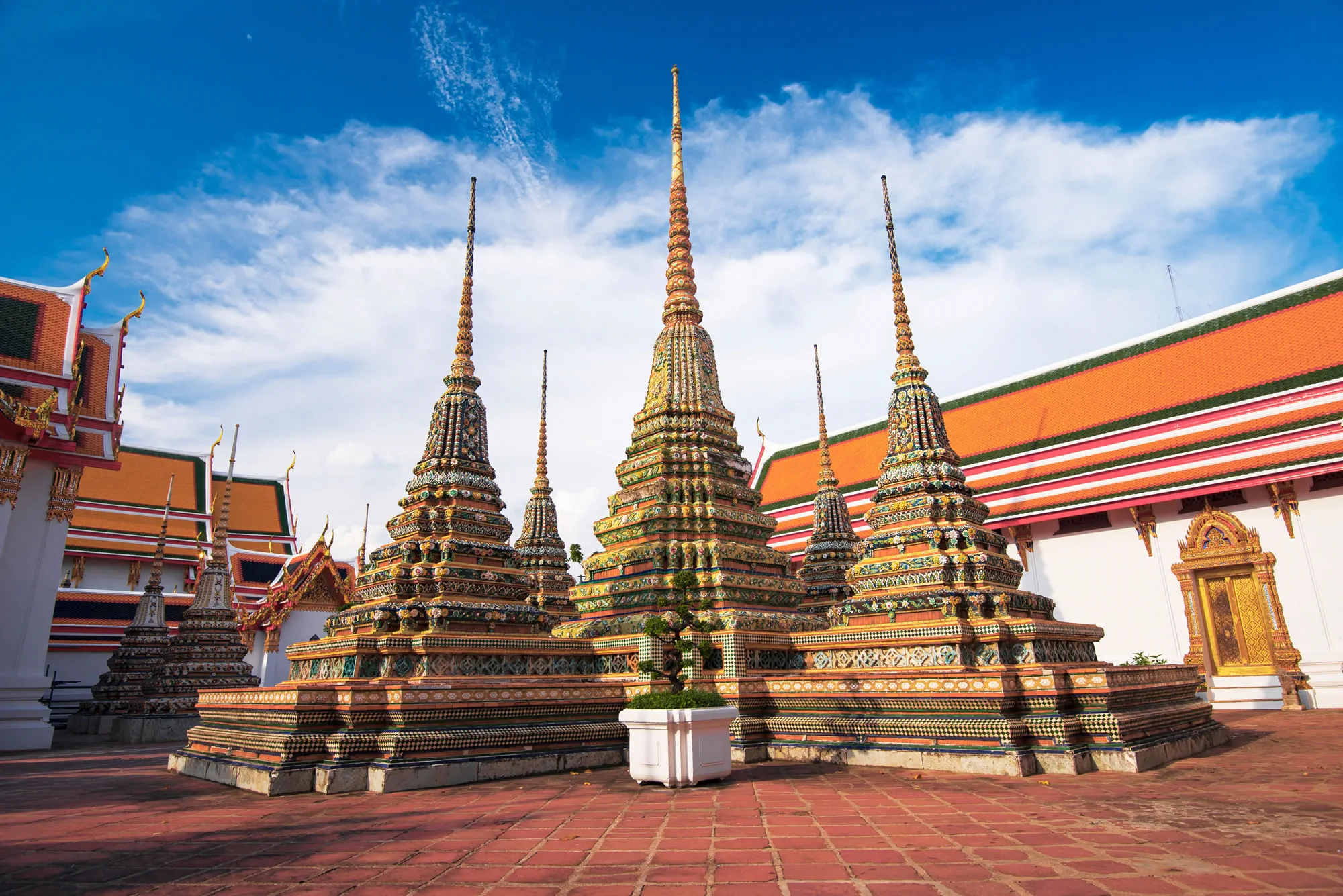
Once you step back out into the sunlight, look for the four towering chedis (stupas) that dominate the skyline. These aren’t just decorative; they are monuments to the Chakri dynasty. Covered in vibrant, intricate floral mosaics made from Chinese ceramics, each chedi is dedicated to one of the first four kings of the dynasty. The green mosaic chedi represents Rama I, the white represents Rama II, the yellow represents Rama III, and the blue represents Rama IV. The level of detail in the ceramic flowers is breathtaking—a testament to the artisans who carefully pieced them together.
The Stone Giants
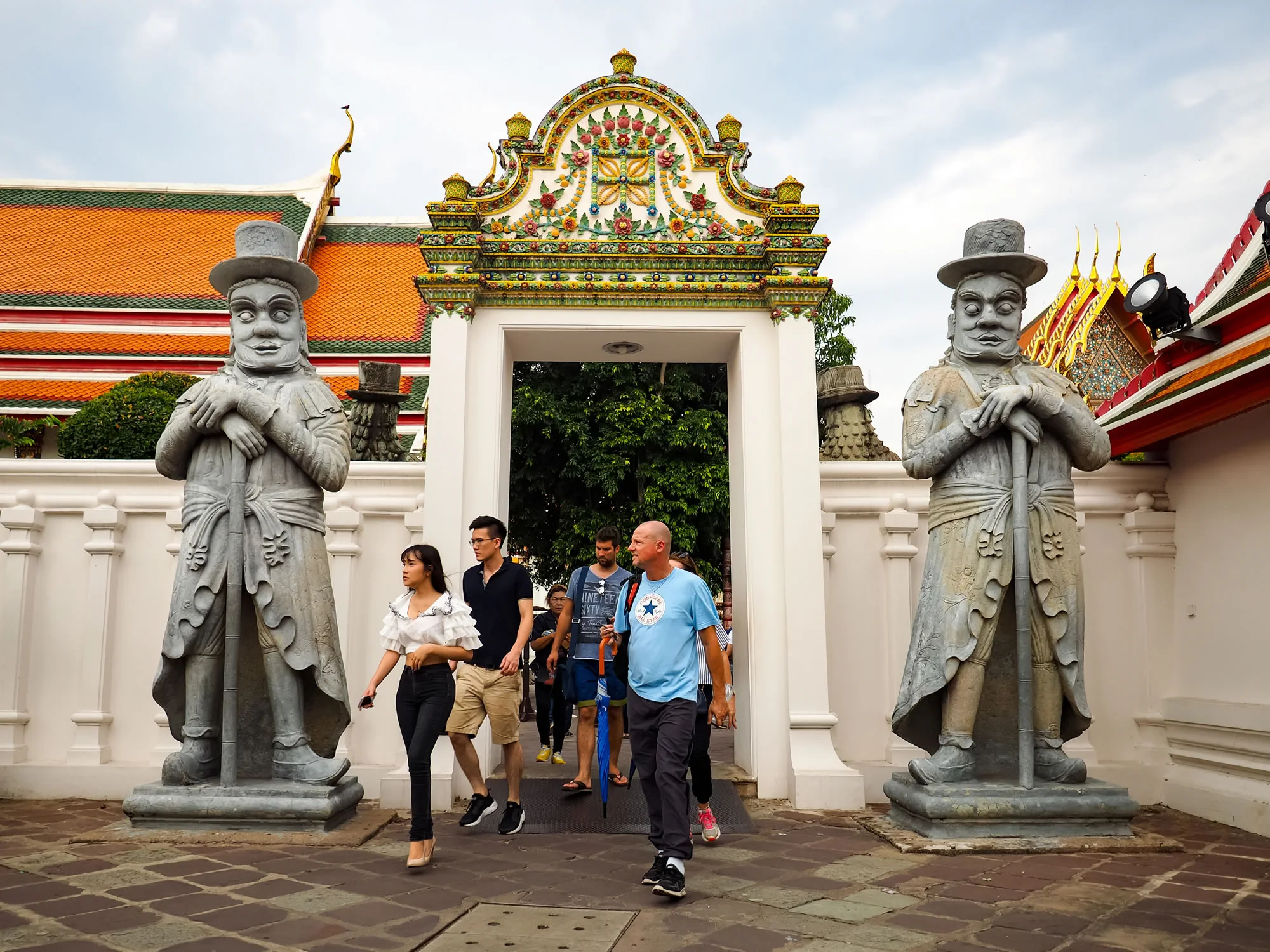
Guardians of the gates, the whimsical stone statues scattered throughout Wat Pho are a favourite among visitors. These rock giants, often depicting Chinese warriors, philosophers, or even Europeans in top hats, have a fascinating backstory. They originally arrived in Siam as ballast on Chinese trading ships. Instead of discarding the heavy stones used to weigh down empty ships on their return journey, the Thai kings repurposed them as temple guardians, adding a unique, multicultural flair to the grounds.
The Cloisters (Phra Rabiang)

If you need a moment of quiet reflection, head to the double cloister surrounding the main ordination hall (Ubosot). Here, you will find nearly 400 gilded Buddha images lined up in perfect serenity. These statues were brought to Bangkok from different parts of Thailand by King Rama I to save them from ruin. Walking along these rows, away from the main crush of tourists, offers a peaceful respite and a chance to appreciate the subtle differences in style from various eras of Thai history.
The Birthplace of Traditional Thai Massage
Historical Significance
Long before modern universities existed, Wat Pho was the centre of learning for the Thai people. King Rama III, fearing that traditional knowledge would be lost, transformed the temple into an "open university." He commissioned scholars to inscribe texts on medicine, history, and literature onto stone tablets placed around the temple walls. Today, these 1,431 inscriptions are recognized as a UNESCO Memory of the World heritage.
The Massage School
Wat Pho isn't just a place to learn about massage history; it is the spiritual home of the practice. The Wat Pho Thai Traditional Medical School, established in 1955, is the oldest massage school in the country. It continues to train therapists who go on to practice worldwide.
Getting a Massage
For the ultimate Bangkok experience, getting a massage here is a must. However, manage your expectations—this isn't a luxury spa with scented candles and private rooms. The experience is communal, taking place in open-air pavilions with rows of beds.
- The Style: Traditional Thai massage is firm and focuses on pressure points and stretching. It can be intense, but you will leave feeling incredibly light.
- The Price: Expect to pay around 340 THB for 30 minutes or 520 THB for 1 hour. While slightly pricier than street-side parlours, your money supports the preservation of this cultural heritage.
The Rishi Statues

As you wander the grounds, keep an eye out for the Rishi Dat Ton statues. These figures depict hermits (Rishi) contorted into various self-stretching yoga poses. They served as a visual textbook for the public, teaching them how to relieve their own aches and pains centuries before YouTube tutorials existed.
Practical Logistics: Planning Your Visit
Opening Hours
Wat Pho is open daily from 08:00 to 19:30. Arriving early helps you beat the heat and the biggest crowds.
Entrance Fee
The current ticket price for foreigners is 300 THB. Children under 120cm can enter for free. Your ticket often includes a coupon for a free bottle of cold water—a lifesaver in the humid Bangkok weather.
Getting There (Seamless Planning)
Bangkok’s traffic is legendary, but getting to Wat Pho doesn't have to be a headache.
- MRT (Subway): This is arguably the easiest and most comfortable option. Take the Blue Line to Sanam Chai Station. Take Exit 1, and you are just a few minutes’ walk from the temple. As a bonus, Sanam Chai is widely considered the most beautiful station in Bangkok, designed to look like a royal stateroom.
- Boat: For a scenic route, take the Chao Phraya Express Boat. Traditionally, you would get off at Tha Tien Pier. However, due to ongoing renovations, verify the current stops. You may need to alight at Wat Arun across the river and take the cross-river ferry (approx. 5 THB) to get to the Wat Pho side.
- Tuk-Tuk: If you are nearby, a tuk-tuk is a classic choice. Just be sure to negotiate the price firmly before you get in to avoid any surprises.
Essential Etiquette and Dress Code
Dress Respectfully
Temples in Thailand are sacred places, and enforcing the dress code is strictly observed. To avoid being turned away at the gate:
- Shoulders: Must be covered. No singlets or tank tops.
- Knees: Must be covered. No short shorts or mini-skirts.
- Transparency: No see-through clothing.
If you are caught out, there are usually sarongs available for rent or purchase nearby, but it is best to arrive prepared.
Footwear
You will need to remove your shoes before entering religious buildings, including the hall of the Reclining Buddha. Wear slip-on shoes or sandals to make this process easier. Shoe racks are provided, or you can carry them in a bag.
Behaviour
Maintain a low volume and be respectful of monks and worshippers. A major cultural taboo in Thailand is pointing your feet at a Buddha image or a person. When sitting on the floor, tuck your legs underneath you (mermaid style) so your feet point backwards.
Safety Assurance
The temple grounds are very safe. However, be wary of friendly strangers outside the temple walls who approach you claiming the temple is "closed" for a holiday, cleaning, or a monk’s ceremony. This is a common scam designed to divert you to a gem shop or a tailor. Smile, say no thank you, and head straight to the main ticket booth to see for yourself.
Suggested Itinerary: Making the Most of Your Day
The "Classic" Route
Wat Pho sits in the historic Rattanakosin district, making it easy to combine with other heavy hitters. A popular route is to visit the Grand Palace (right next door) first thing in the morning when it opens, then walk to Wat Pho afterwards. Finish your day by taking the ferry across the river to Wat Arun (Temple of Dawn).
Timing
- Early Morning (08:00): This is the best time for photographers and those who want to experience the temple’s serenity before the tour buses arrive.
- Late Afternoon (16:30): Visit later in the day to enjoy the "golden hour" light reflecting off the chedis. If you stay until 17:00 or 18:00, you might catch the evening chanting ritual of the monks—a mesmerizing auditory experience.
Food & Drink
After your massage and exploration, you’ll likely be hungry. Head to the nearby Tha Tien Market area for amazing street food. Alternatively, grab a table at a riverside cafe overlooking Wat Arun for a sunset drink. Watching the sun dip behind the Temple of Dawn while sipping a cold drink is the perfect end to a day of cultural immersion.
An Unmissable Thai Experience
Wat Pho offers a perfect blend of history, wellness, and artistic beauty that defines the Thai experience. It is a place where golden giants sleep, stone warriors stand guard, and the ancient wisdom of healing is still practiced daily.
Don’t just rush through for the photo. Take the time to drop a coin in a bowl, study the mother-of-pearl feet, and soothe your travel-weary muscles with a traditional massage. By slowing down and soaking in the details, you connect with the true spirit of Bangkok.




















Michael Carter
Vestibulum ante ipsum primis in faucibus orci luctus et ultrices posuere cubilia curae; Donec vel erat in nulla efficitur tempor non ut nisl. Integer venenatis eros ut dui viverra fermentum.
Sophie Wilson
Nam ut turpis hendrerit, varius nunc vel, elementum dui. Morbi vulputate dolor sit amet scelerisque egestas. Vestibulum eleifend nunc ut bibendum fermentum.
Alex Morgan
Cras non velit nec purus tempor rhoncus. Sed non mauris vitae erat consequat auctor eu in elit. Class aptent taciti sociosqu ad litora torquent per conubia nostra.